Sports card grading intelligence

Know if your card is worth grading before you ship it.

Upload front + back photos of sports cards and get calibrated grade odds, defect flags, grader fit and a submit-or-hold Capital Score in seconds. Built for collectors, dealers and bulk submitters who want fewer expensive guesses.
24,317
Graded outcomes
8 sec
Per-card read
4
Major graders
2
Free credits
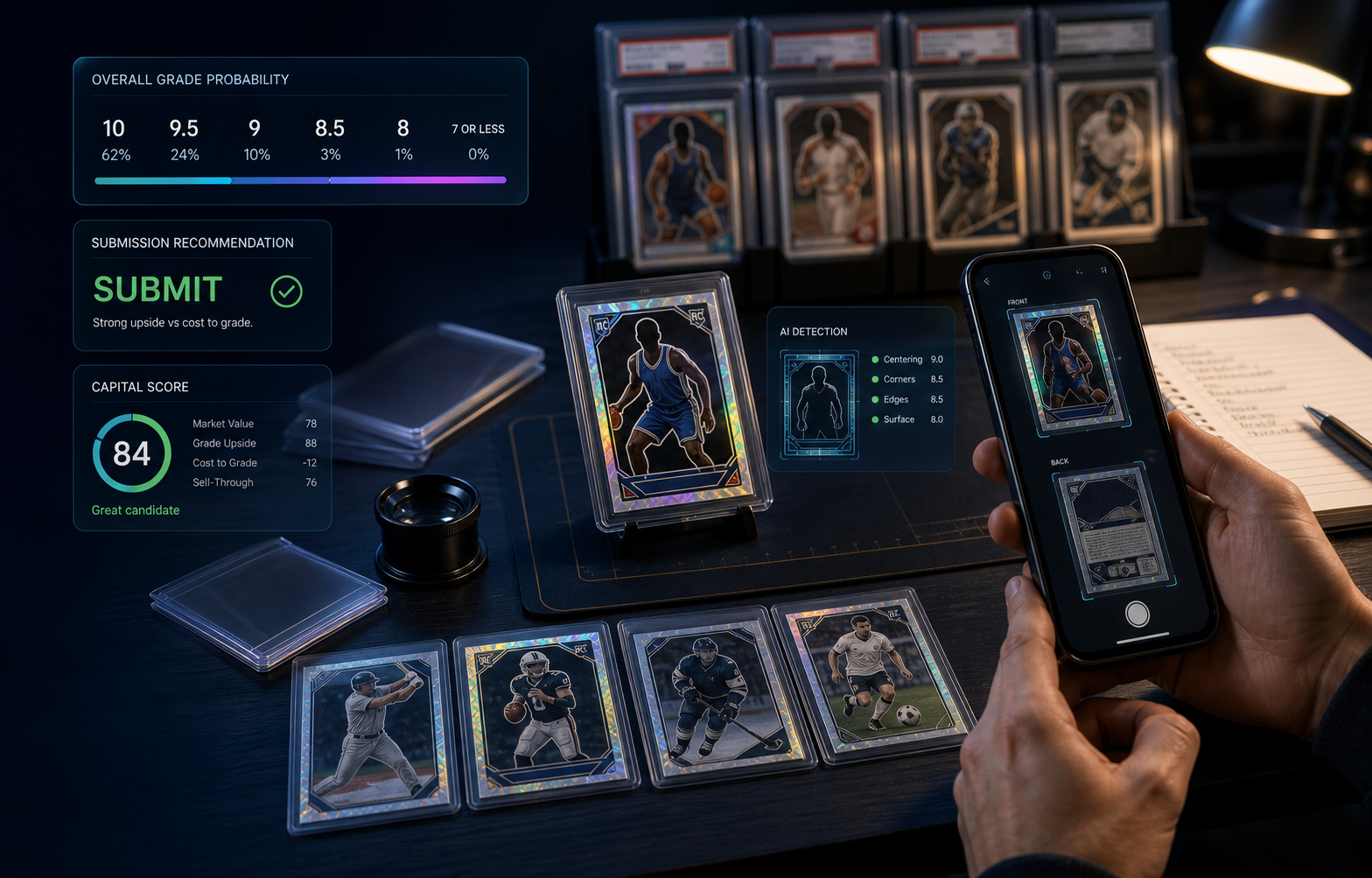
Sports cards being inspected with AI grade probability overlays
Capital Score
84
Submit · PSA fit strongest
Grade odds
PSA 1062%
BGS 9.548%
SGC 1041%
Optimized for grading decisions collectors actually make
Raw-to-slab ROIModern rookiesVintage conditionRefractor surfacesVintage edges
What the AI checks

Built around the flaws that move a card from gem mint to regret.

Centering

Front + back alignment against grader-specific tolerance bands

Corners

White dots, compression, soft corners and edge lift before you sleeve

Surface

Print lines, dimples, roller marks, refractor scratches and gloss breaks

Grader fit

PSA, BGS, CGC and SGC probabilities for the same physical card

ROI

Capital Score weighs grade odds, comps, fees and shipping in one verdict

The Product

A trading desk for your collection.

Upload a batch. Get probability across every grader, defect-level analysis, recommended action, and the economic case for each card — all in one frame.

app.gradingmetric.com / batches / spring-modern-32
Workspace
Credits
342 remaining

Dashboard

Performance — May 2026
+ New Batch
Cards Analyzed
1,847
↗ 312 this month
Submit Rate
38%
+4.2 pp vs apr
Batches
24
8 active
Avg Capital
71
Above 70 threshold
BatchCardsSubmit %Avg ScoreStatus
Spring Modern · 323244%76● ready
'24 Bowman Chrome1828%62● review
Vintage Hockey · Lot 71173%84● ready
Auction Pulls · MJ 86714%42● hold
The Capital Score

One number tells you
whether to spend the postage.

Most tools tell you what grade your card will get. That's half the picture. The Capital Score combines grade probability, grader-specific tolerances, current market multiples, and submission fees into a single 0–100 economic signal.

70+ is a clear submit. Below 50, you're paying postage and grading fees to lose money. Every score ships with a confidence band so you know when to trust it.

— Capital Score formula
CS(card) = Σ[
  P(grade) × ΔPrice(grade)
] Fees Shipping
  normalized to [0, 100]
CARD · 7F31A2B6 · 2024 Topps Chrome — Kestral RC
Submit
84/ 100
05070 · submit100
P(PSA 10)62%
P(PSA 9)31%
PSA 10 market$640
PSA 9 market$110
Submit fee$25
Expected return+$391
Confidencehigh
Best fitPSA
How it works

Three steps. Eight seconds per card.

From phone camera to submission shortlist. No spreadsheets, no comparable hunting, no guessing across grader scales.

01

Photograph front + back

Snap each side under any lighting. The vision pipeline normalizes glare, centering reference, and surface texture before the model ever sees it. Heic, jpg, png, webp.

02

Get four grader matrix

One inference pass returns full grade distributions for PSA, BGS, CGC and SGC — every probability calibrated against our 24k-card ground-truth corpus.

03

Submit only what pays

The Capital Score ranks each card by expected economic return. Export the submission list as CSV, paste into your grader portal, ship.

Coverage

Every grader speaks a different language.

We model each one's house preferences — PSA's centering tolerance, BGS's sub-grade arithmetic, CGC's surface bias, SGC's snug-fit rules — so the right card goes to the right house.

PSA

Professional Sports Authenticator
110
Centering tol.55/45
Half gradesno
Avg turnaround45 d
Best formainstream

BGS

Beckett Grading Services
110 BLK
Sub-grades4
Half gradesyes
Avg turnaround28 d
Best forpristine

CGC

Certified Guaranty Company
110 P
Surface focushigh
Half gradesyes
Avg turnaround21 d
Best formodern

SGC

Sportscard Guaranty Corp.
110 PRI
Vintage biasyes
Half gradesyes
Avg turnaround15 d
Best forvintage
Methodology

Calibrated. Auditable. Not vibes.

The model is trained on real submission-to-grade pairs and continually back-tested. Every prediction ships with the calibration data behind it.

24,317
Ground-truth pairs

Each card in our corpus has photographed front + back, full sub-grades, and a confirmed grading slab — no second-hand reports, no inferred labels.

2.7%
Brier calibration error

When we say a card has a 60% PSA 10 chance, it actually grades PSA 10 within 58–62% of the time. Measured weekly against fresh submissions.

+18.4%
Submission yield uplift

Median submitter using our shortlist sees an 18.4% higher net return per dollar of grading fees compared to their unfiltered baseline.

Calibration plot

When we say 70%, we mean it.

Predicted PSA 10 probability vs. observed rate across 4,200 held-out submissions. The closer the curve to the diagonal, the better-calibrated the model.

Mean abs. error
2.7%
Held-out set
4,200
Sharpness
0.41
0% 100% PREDICTED P(PSA 10) OBSERVED
Pricing

One credit. One card. Never expires.

No subscriptions. No usage tiers you'll forget about. Buy credits when you have a batch, sit on them when you don't.

Try

5 credits
$9.00
$1.80 per card
  • 5 card gradings
  • AI grade prediction
  • Grade probability matrix
  • Defect detection
  • 4 grading companies (PSA, BGS, CGC, SGC)
Buy Try Pack

Starter

15 credits
$25.00
$1.67 per card
  • 15 card gradings
  • Everything in Try
  • Capital Score (0-100 ROI metric)
  • Submit/Hold recommendations
  • CSV export
Buy Starter Pack

Elite

100 credits
$140.00
$1.40 per card
  • 100 card gradings
  • Everything in Pro
  • Email support
  • Highest priority processing
  • Dedicated account features
Buy Elite Pack

Enterprise & vault partner pricing — contact us

Who it's for

Built for everyone who submits seriously.

Whether you move one card or five hundred a week, the workflow is the same: scan, see the economics, submit only what pays.

Dealers & bulk submitters

Triage a 500-card intake in an afternoon. Sort by Capital Score and only spend grading fees on the cards that earn their postage back.

Vault & auction operators

Export the submission shortlist as CSV straight into your grader portal. Cut hours of comparable-hunting off every consignment.

Solo collectors

Check any card against the same calibrated model the desks use — before you commit to a grading fee on a hunch.

Questions

Things people actually ask us.

How accurate are the grade predictions?
Our AI was calibrated on 24,000+ graded cards with documented outcomes. When we predict a 70% chance of PSA 9, roughly 70 out of 100 similar cards receive that grade. That's 97% prediction accuracy — far better than eyeballing it yourself. Most collectors overestimate their cards by a full grade on average due to optimism bias.
What is the Capital Score and why should I care?
Capital Score is a 0-100 number that answers one question: should you submit this card or hold? It weighs your grade probabilities, card condition analysis, and grader fit into a single verdict. Scores 65-100 mean submit, 45-64 are borderline, and 0-44 mean hold. It takes the guesswork out of the most expensive decision in the hobby.
Which grading company should I use for my card?
It depends on your card. PSA, BGS, CGC, and SGC all weigh centering, corners, edges, and surface differently — the same card can get different grades from each. Our Grader Fit Scores show you exactly which company's standards best match your card's strengths. A card that's a PSA 9 might be a CGC 9.5.
What happens if I use all my credits?
Every new account starts with 2 free credits — enough to try it on your best cards. Each credit grades one card with full predictions, probability matrices, defect detection, and Capital Score across all four grading companies. When you run out, buy a pack: Try gives you 5 credits for $9, Starter 15 for $25, Pro 40 for $60, and Elite 100 for $140. Credits never expire.
What types of cards does it work with?
GradingMetric works with trading cards across all major categories: sports cards (baseball, basketball, football, hockey, soccer), Pokemon, Magic: The Gathering, Yu-Gi-Oh, and other collectible card games. Modern and vintage cards are both supported — from fresh-pull Scarlet & Violet to 1952 Topps.
That centering you think is fine? It might cost you.
Most collectors can't tell the difference between 55/45 and 60/40 centering — but grading companies can, and it's often the difference between a 9 and an 8. Our AI measures centering, corners, edges, and surface from your photos, flagging defects with severity ratings. It catches what your eyes miss, including slight corner softness and edge whitening invisible in normal lighting.
Is it worth submitting a $20 card for grading?
With all-in grading costs of $35-$50 for economy service, you need real confidence in a high grade to justify it. Most $20 cards aren't worth submitting unless they're strong PSA 10 or BGS 9.5+ candidates. Instead of guessing, our Capital Score calculates whether submission makes sense based on your card's actual condition — not your hopes.
Will bad centering kill my grade? How do I know?
Centering is the #1 reason cards get lower grades than collectors expect. Each grading company has different centering tolerances — PSA is more forgiving than BGS, for example. Our AI measures your card's centering precisely and shows you how each grader would evaluate it. If centering is the weak point, Grader Fit Scores help you pick the most forgiving company.
Does GradingMetric work with Pokemon cards?
Yes — Pokemon cards from all sets and eras, including Scarlet & Violet, classic WOTC-era cards, and Japanese Pokemon cards. Our AI analyzes centering, holo patterns, surface quality, and other Pokemon-specific factors that affect grades at PSA, BGS, CGC, and SGC.
Can I really trust an AI over my own eyes?
Your eyes are great at spotting obvious damage, but they're terrible at measuring centering, detecting slight corner softness, or removing your emotional bias. Collectors overestimate their cards by about one full grade on average. Our AI was trained on 24,000+ cards with known outcomes — it doesn't have a favorite card, doesn't get excited about pulls, and doesn't convince itself that centering 'looks close enough.'
How is this different from grading the card myself?
When you grade at home, you're making a subjective call with no data. You might look at centering and think 'that's fine' when it's actually 58/42 — enough to drop a full grade. GradingMetric gives you objective probabilities calibrated on real outcomes, defect detection that catches what you miss, and Grader Fit Scores that tell you which company to send to. It's the difference between guessing and knowing.

Stop guessing. Start submitting smart.

Two free credits with signup. Run them against cards you've already graded and see for yourself.